Social Security 2027: the COLA, the Part B premium and the trust funds
Published 2026-11-05 · COLA announced 2026-10-14 · SSA, CMS and Trustees figures · Free to republish (CC BY 4.0)
On this page: The paragraph COLA calculator Story angles The raise vs. Part B Every year Trust funds Downloads Sources Contact
For most of the people with Medicare, the Social Security check and the Part B premium are the same story: the premium comes out of the check before it is deposited. The cost-of-living adjustment is the headline; what lands in the account is the raise minus the premium change. Here are both, every year they are published, and a calculator readers can use on their own benefit.
The numbers in a paragraph
Paste it as is, or take what you need. Please keep the credit: it links readers to the calculator and the tables.
Source: Social Security Administration COLA history and fact sheets; CMS Part B premiums; 2025 Trustees Reports; compiled by MyMedicarePlans.org (https://mymedicareplans.org/newsroom/social-security/)
The COLA calculator: put it on your story
Readers type their monthly benefit: the COLA raise in dollars, the Part B premium change (once CMS announces it), the net change in their deposit and the hold-harmless rule. Preset a benefit with ?benefit=1800.
<iframe src="https://mymedicareplans.org/embed/cola-calculator/" title="Your Social Security raise in 2027, after Medicare Part B" width="100%" height="560" style="border:0;max-width:640px" loading="lazy" allowtransparency="true" data-mmp-embed></iframe>
<script src="https://mymedicareplans.org/embed/resize.js" async></script>
<p style="font:13px/1.4 sans-serif;margin:4px 0 0">Social Security COLA calculator: <a href="https://mymedicareplans.org/newsroom/social-security/">MyMedicarePlans.org</a></p>
Story angles in the data
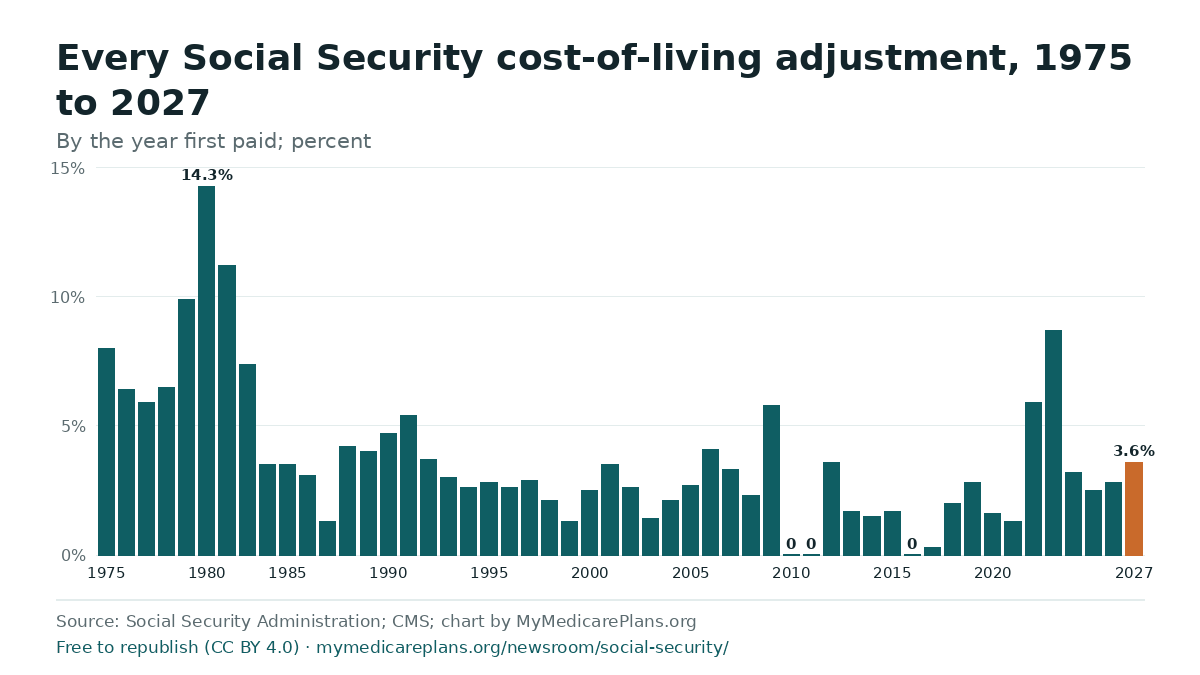
- The 2027 raise. 3.6% from January 2027, the largest since 2023: about $74.56 a month on the average retired worker's $2,071. Readers can run their own number with the calculator below.
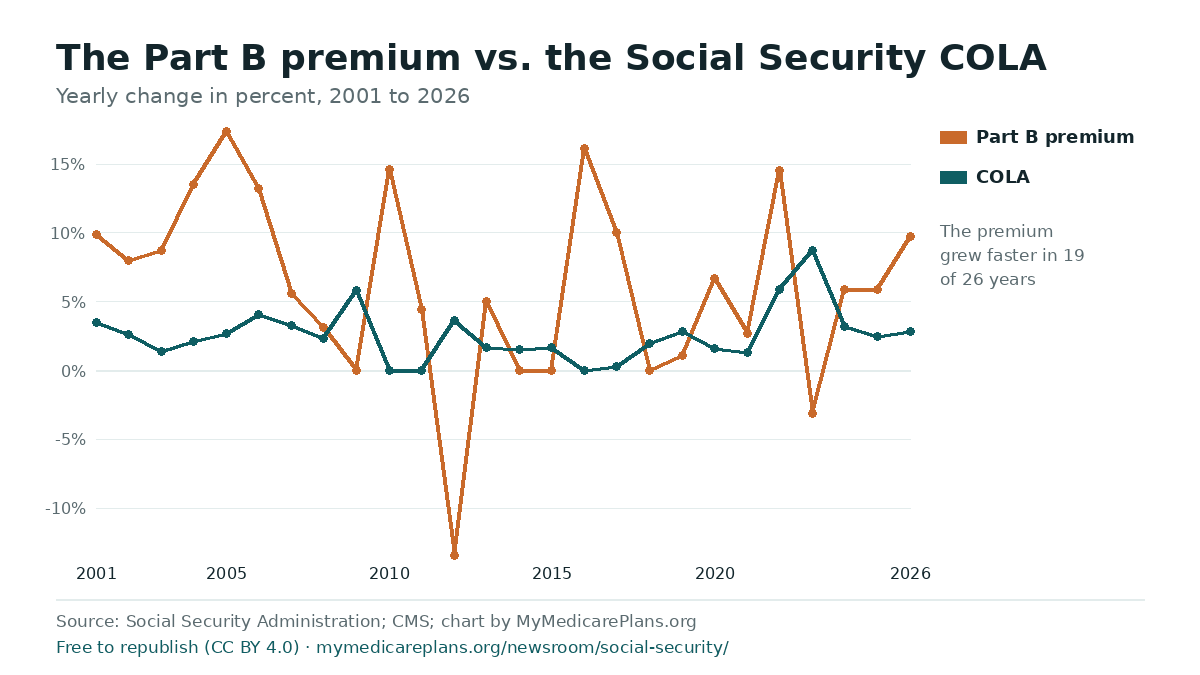
- Part B outpaces the COLA. From 2000 to 2026 the Part B standard premium grew 346% ($45.50 to $202.90); the COLAs compounded to 94%. The premium grew faster than the COLA in 19 of 26 years.
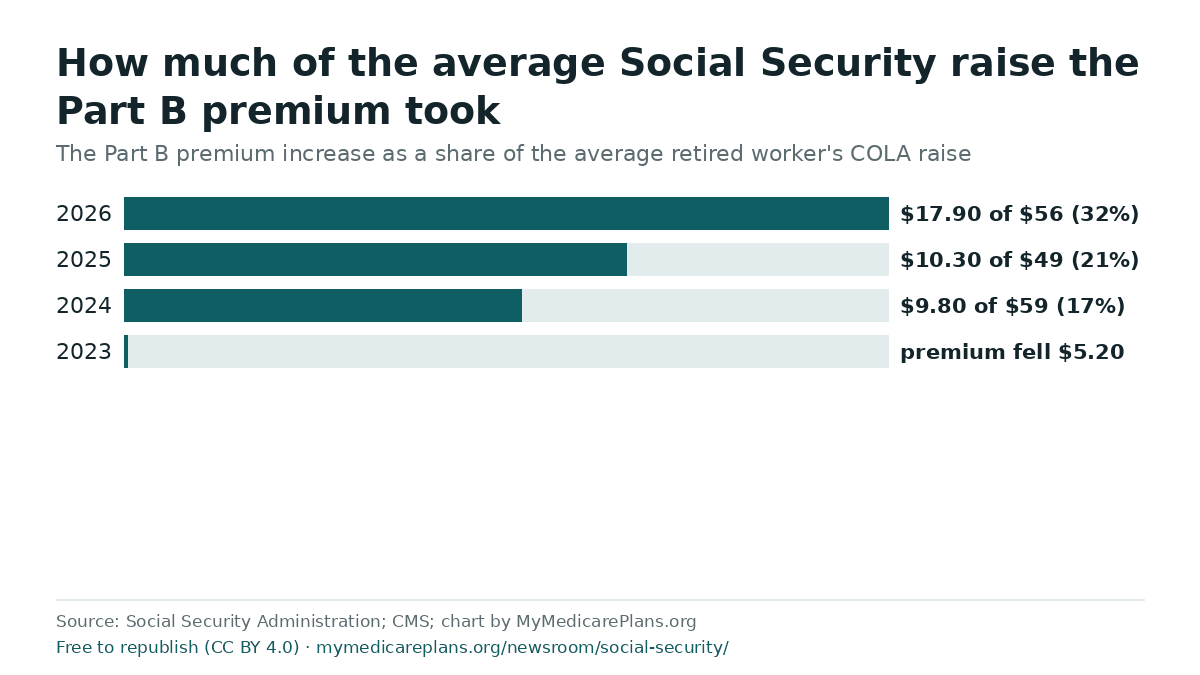
- How much of the raise Part B took. 2023: the premium fell $5.20, on top of a $146 raise; 2024: $9.80 of a $59 average raise (17%); 2025: $10.30 of a $49 average raise (21%); 2026: $17.90 of a $56 average raise (32%).
- The number still to come. CMS has not announced the 2027 Part B premium (usually in November). When it does, the net raise in most retirees' deposits is the COLA minus the premium change: the calculator on this page updates the day the figure is added.
- The hold-harmless rule. Most people whose Part B premium is taken from their Social Security cannot see their deposit go down because of a premium increase: the increase is capped at their raise. It does not protect new enrollees, people paying the income-related surcharge (IRMAA), or people whose premium is paid by Medicaid. No-COLA years (2010, 2011, 2016) left most people's premium frozen and shifted the increase onto everyone else.
- The trust fund countdown. The 2025 Trustees Reports: Social Security's retirement fund (OASI) runs out in 2033, then pays 77% of benefits; combined with disability (OASDI), 2034 and 81%; Medicare's hospital fund (Part A), 2033 and 89%. A 23% cut on today's average retired benefit ($2,071) is about $476 a month.
- WEP and GPO are gone. The Social Security Fairness Act, signed 2025-01-05, repealed the Windfall Elimination Provision and the Government Pension Offset, which had reduced the Social Security benefits of many people with a pension from work not covered by Social Security, for benefits payable after December 2023. Teachers, police, firefighters and other public workers in your area are the people to ask how it changed their checks.
- Questions to ask. The local SSA field office's wait times; the state's SHIP on how many callers ask about Part B deductions; and the state's Medicare Savings Programs, which pay the Part B premium for people with low incomes and so give the whole COLA back.
How much of the raise does Part B take?
SSA publishes an estimated average retired-worker benefit with each COLA. The Part B premium change for the same January, as a share of that average raise:
| Year | Average before | Average after | Raise | Part B change | Share of the raise |
|---|---|---|---|---|---|
| 2026 | $2,015 | $2,071 | +$56 | $17.90 | 32% |
| 2025 | $1,927 | $1,976 | +$49 | $10.30 | 21% |
| 2024 | $1,848 | $1,907 | +$59 | $9.80 | 17% |
| 2023 | $1,681 | $1,827 | +$146 | $-5.20 | none: it fell |
Every year since 2000
The COLA first paid each January beside the Part B standard premium for that year. A bold change: the premium grew faster than the COLA. * The hold-harmless rule kept many people's premium lower (hover for the detail):
| Year | COLA (from January) | Part B standard premium | Change | Change % |
|---|---|---|---|---|
| 2027 | 3.6% | not announced | ||
| 2026 | 2.8% | $202.90 | +$17.90 | +9.7% |
| 2025 | 2.5% | $185.00 | +$10.30 | +5.9% |
| 2024 | 3.2% | $174.70 | +$9.80 | +5.9% |
| 2023 | 8.7% | $164.90 | −$5.20 | -3.1% |
| 2022 | 5.9% | $170.10 | +$21.60 | +14.5% |
| 2021 | 1.3% | $148.50 | +$3.90 | +2.7% |
| 2020 | 1.6% | $144.60 | +$9.10 | +6.7% |
| 2019 | 2.8% | $135.50 | +$1.50 | +1.1% |
| 2018 | 2.0% | $134.00 | +$0.00 | +0.0% |
| 2017 * | 0.3% | $134.00 | +$12.20 | +10.0% |
| 2016 * | 0.0% | $121.80 | +$16.90 | +16.1% |
| 2015 | 1.7% | $104.90 | +$0.00 | +0.0% |
| 2014 | 1.5% | $104.90 | +$0.00 | +0.0% |
| 2013 | 1.7% | $104.90 | +$5.00 | +5.0% |
| 2012 | 3.6% | $99.90 | −$15.50 | -13.4% |
| 2011 * | 0.0% | $115.40 | +$4.90 | +4.4% |
| 2010 * | 0.0% | $110.50 | +$14.10 | +14.6% |
| 2009 | 5.8% | $96.40 | +$0.00 | +0.0% |
| 2008 | 2.3% | $96.40 | +$2.90 | +3.1% |
| 2007 | 3.3% | $93.50 | +$5.00 | +5.6% |
| 2006 | 4.1% | $88.50 | +$10.30 | +13.2% |
| 2005 | 2.7% | $78.20 | +$11.60 | +17.4% |
| 2004 | 2.1% | $66.60 | +$7.90 | +13.5% |
| 2003 | 1.4% | $58.70 | +$4.70 | +8.7% |
| 2002 | 2.6% | $54.00 | +$4.00 | +8.0% |
| 2001 | 3.5% | $50.00 | +$4.50 | +9.9% |
| 2000 | 2.5% | $45.50 |
Embed this table on your site · Style it to match your site
- 2010: No COLA was paid in 2010, so the hold-harmless rule kept most people with Social Security at $96.40.
- 2011: No COLA again: most people with Social Security still paid $96.40 (or $110.50 if they joined in 2010).
- 2016: No COLA was paid in 2016: about 70% of enrollees, those held harmless, kept paying $104.90.
- 2017: The 0.3% COLA was too small to cover the increase: held-harmless enrollees paid less than $134.00.
The trust fund countdown
From the 2025 Trustees Reports (released 2025-06-18), the latest in the newsroom's file. The disability (DI) trust fund is not projected to run out within the 75-year window. At depletion, incoming payroll taxes and other income would still pay the share shown; the law does not allow the funds to pay more.
What the payable share would mean on today's average retired-worker benefit ($2,071 a month, SSA's January 2026 estimate), in today's dollars (the newsroom's arithmetic, not a forecast of any one person's check):
| Fund | Runs out | Years from now | Payable | On the average benefit |
|---|---|---|---|---|
| Social Security retirement and survivors (OASI) trust fund | 2033 | 7 | 77% | $1,595 |
| Social Security retirement, survivors and disability combined (OASDI, hypothetical) | 2034 | 8 | 81% | $1,678 |
Free to republish
The charts and data on this page are free to use under Creative Commons Attribution 4.0: credit MyMedicarePlans.org with a link to this page. The figures are SSA's and CMS's, public and free to use; the table puts them side by side, one row a year.
COLA and Part B, every year (CSV)COLA history (PNG)COLA vs. Part B (PNG)Share of the raise (PNG)
Sources and limits
- Social Security Administration, Cost-of-Living Adjustments (COLA) history: every COLA, by the year SSA lists it
- Social Security Administration, COLA fact sheets (the estimated average monthly benefit for all retired workers, before and after each COLA): the average retired-worker benefit
- CMS, Medicare Parts A & B premiums and deductibles fact sheets (each November), and the Medicare Trustees Reports' Part B premium history: the Part B standard premium each year
- Medicare.gov, Part B costs (the hold-harmless provision, Social Security Act section 1839(f)): the hold-harmless rule
- The 2025 Social Security and Medicare Trustees Reports (released June 18, 2025): the trust fund dates and payable shares
- Social Security Administration, Social Security Fairness Act: Windfall Elimination Provision (WEP) and Government Pension Offset (GPO) Update: WEP and GPO
- The Medicare Trustees Report (CMS)
- SSA lists each COLA under the year it takes effect (June through 1982, December from 1983). year_paid is the year of the first check carrying it: July for 1975-1982; the 1983 COLA was delayed to the January 1984 check, and every COLA since is first paid in January.
- Part B: the standard monthly premium for the calendar year. Years where many people paid less under the hold-harmless rule are noted.
- Census ACS B19055 (households with Social Security income) was tried on 2026-11-05: api.census.gov now requires a key, so no county figures are in this file.
- The COLAs from 2026 on and the current Part B premium come from the site's program file, updated the day SSA or CMS announces them. The dollar figures on the average benefit are the newsroom's arithmetic on SSA's published average.
Embed the tables on this page
Every table here can go on your site: searchable, sortable, filterable, with the CSV a click away. Paste the code where the table should appear. It sizes itself to fit; add ?state=ohio to start on a state, or ?bg=transparent to sit on your page's own background. Fonts, colors and the rest: the Embed Studio.
Questions about the data
Write to [email protected]: a custom cut of the data (a county list, a region, a chart in your outlet's size) is usually a same-day reply.
For a quote or an interview, write to the same address and the desk that covers it answers: the Data Desk for the plan counts and the county data, the Costs & Policy Desk for Part D, premiums, IRMAA and Extra Help, the Editorial Desk for how Medicare works, Medigap and enrollment. Every answer comes from the CMS files and Medicare's own rules.
MyMedicarePlans.org is a Medicare guide: plain-language answers and plan data for people choosing coverage. The counts here come only from the CMS files, and the method is above. Not connected with or endorsed by the U.S. government or the federal Medicare program.