Medigap underwriting: who could be turned down, state by state
Published 2026-11-03 · KFF analysis published 2026-10-13 · Credit KFF for its figures
On this page: The paragraph Downloads Embed Story angles What gets people declined By age Every state State windows Approval rates Sources Contact
Outside Medigap Open Enrollment and a guaranteed issue right, a Medigap insurer can ask about an applicant's health and turn them down, or charge more. That matters this fall: people leaving a Medicare Advantage plan who want a Medigap policy face those questions unless they apply in time. Here is what the public record says about who could be declined and where state law protects them, from KFF's October 2026 analyses, beside the newsroom's count of the plans ending.
The numbers in a paragraph
Paste it as is, or take what you need. Please keep the credit: it links readers to the state table and the sources.
Source: KFF analysis of 2023 Medicare Advantage data (October 2026); state rules, KFF; compiled with CMS plan counts by MyMedicarePlans.org (https://mymedicareplans.org/newsroom/medigap/underwriting/)
Downloads, and the credit
The figures on who could be turned down, and the state rules, are KFF's: credit KFF when you use them (the analysis, the state rules). The plan counts and the way the data is put together here are the newsroom's, free to use with a link to this page. The CSV has one row a state: KFF's share and number, the state's window and switching rule, and the CMS plan counts.
Every state (CSV)Map (PNG)Conditions chart (PNG)
Put the state lookup on your site
Readers pick a state: the share of Medicare Advantage enrollees who could be turned down (KFF), the state's windows and switching rules, and the plans ending there.
<iframe src="https://mymedicareplans.org/embed/medigap-underwriting/" title="Could you be turned down for a Medigap policy?" width="100%" height="520" style="border:0;max-width:640px" loading="lazy" allowtransparency="true" data-mmp-embed></iframe>
<script src="https://mymedicareplans.org/embed/resize.js" async></script>
<p style="font:13px/1.4 sans-serif;margin:4px 0 0">Medigap underwriting by state: <a href="https://mymedicareplans.org/newsroom/medigap/underwriting/">MyMedicarePlans.org</a></p>
Story angles in the data
- Three in four could be turned down. 74% of Medicare Advantage enrollees (20.9 million) had a condition listed on most Medigap applications, KFF found; by age: Under 65 77%; 65 to 74 66%; 75 to 84 79%; 85 and older 88%.
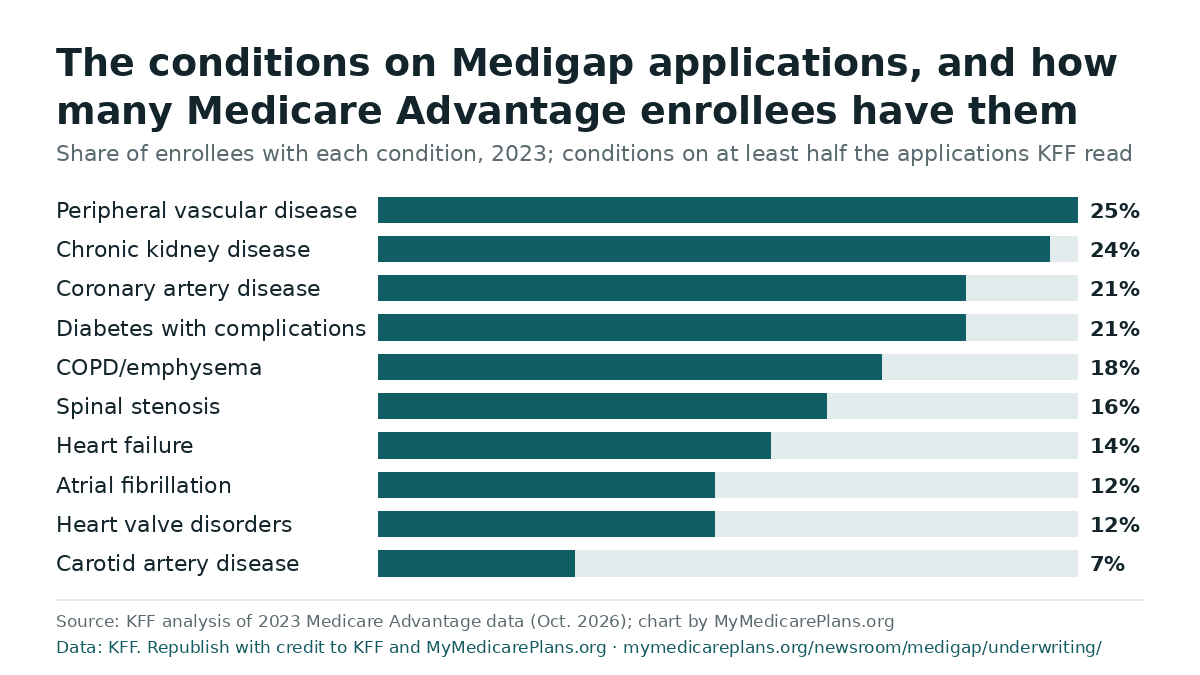
- What gets people declined. The most common conditions among Medicare Advantage enrollees that the applications ask about: Peripheral vascular disease (PVD) (25%); Chronic kidney disease (CKD) (24%); Coronary artery disease (21%); Diabetes with complications (21%); COPD/emphysema (18%). Applications also ask about a recent hospital stay, home health care, nursing facility care and tests, treatment or surgery a doctor has recommended that have not happened yet.
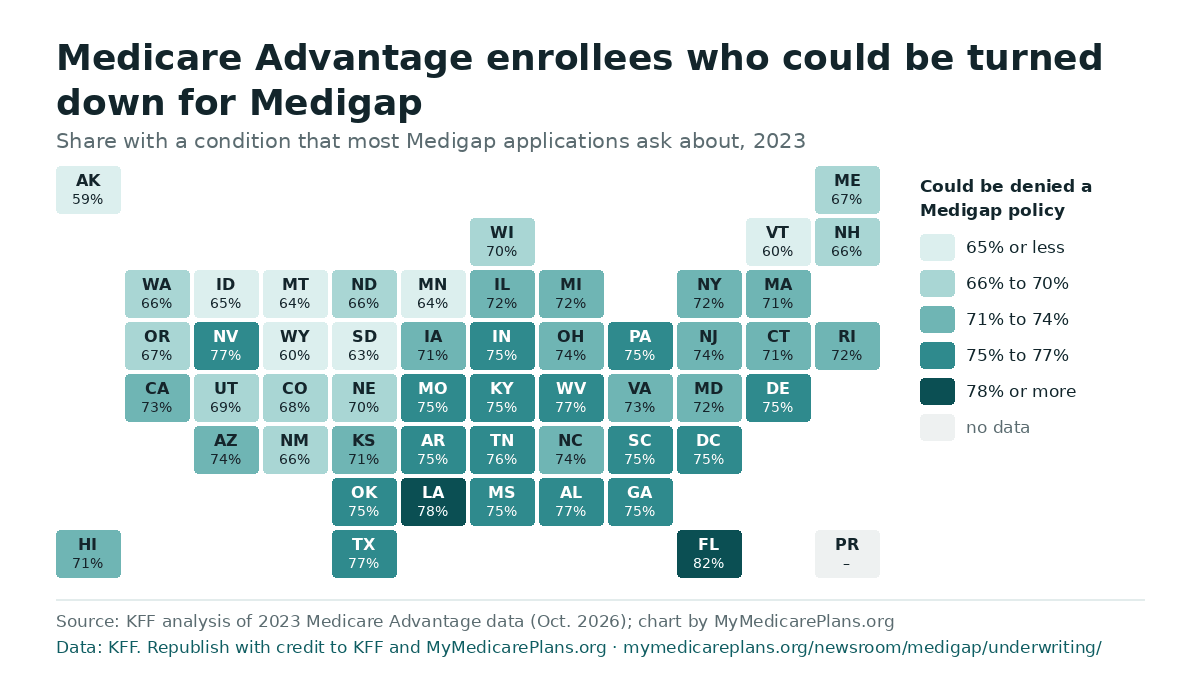
- Where the share is highest. Florida (82%); Louisiana (78%); Alabama (77%); Nevada (77%). Lowest: Alaska (59%); Wyoming (60%); Vermont (60%).
- The 63-day window. Members of the 759 Medicare Advantage plans ending outright for 2027 (and anyone whose plan stops covering where they live) can buy certain Medigap policies without health questions if they apply no more than 63 days after the coverage ends. Miss it, and the health questions apply.
- Where state law steps in. KFF counts eight states with continuous or annual protections of some kind: Connecticut and New York year-round, Massachusetts year-round in practice, Maine for Plan A one month a year, Delaware and Rhode Island for Medicare Advantage enrollees, Minnesota once for ages 65 to 70, and Illinois through one insurer's own policy. The 16 birthday-rule states help only people who already have a Medigap policy.
- Plans ending, and no state window. States with no continuous or annual window where the most plans are ending outright: Texas (67 plans ending; 77% of enrollees could be turned down); Florida (65 plans ending; 82% of enrollees could be turned down); California (55 plans ending; 73% of enrollees could be turned down); Ohio (36 plans ending; 74% of enrollees could be turned down).
- The number no one publishes. Insurers do not report how many Medigap applications they approve, rate up or decline, and CMS and the NAIC do not collect it. The insurers whose applications KFF read: UnitedHealthcare, Mutual of Omaha, Health Care Service Corporation (Blue Cross and Blue Shield of Texas), CVS Health (Aetna), Elevance Health (Wellpoint), Humana. Ask them, and the state insurance department, for their numbers.
What gets people declined
KFF read the Medigap applications of the six insurers with the most Medigap members (UnitedHealthcare, Mutual of Omaha, Health Care Service Corporation (Blue Cross and Blue Shield of Texas), CVS Health (Aetna), Elevance Health (Wellpoint), Humana) filed in California, Texas and Illinois, and kept the conditions asked about on at least half of them. The share is of Medicare Advantage enrollees with each in 2023 (shares overlap: many people have more than one). The applications also ask about a recent hospital stay, home health care, nursing facility care and tests, treatment or surgery a doctor has recommended that have not happened yet.
| Condition the applications ask about | Medicare Advantage enrollees with it |
|---|---|
| Peripheral vascular disease (PVD) | 25% |
| Chronic kidney disease (CKD) | 24% |
| Coronary artery disease | 21% |
| Diabetes with complications | 21% |
| COPD/emphysema | 18% |
| Spinal stenosis | 16% |
| Heart failure | 14% |
| Atrial fibrillation | 12% |
| Heart valve disorders | 12% |
| Carotid artery disease | 7% |
| Drug use disorder | 7% |
| Alzheimer's disease/dementia | 6% |
| Kidney failure | 6% |
| Stroke/Transient Ischemic Attack (TIA) | 6% |
| Presence of a pacemaker or heart assist device | 4% |
| Aortic or cardiac aneurysm | 4% |
| Bipolar disorder | 4% |
| Breast cancer | 4% |
| Prostate cancer | 4% |
| Rheumatoid arthritis | 3% |
| Alcohol use disorder | 3% |
| Heart attack (acute myocardial infarction) | 2% |
| Pancreatitis | 2% |
| Schizophrenia | 2% |
| Parkinson's disease | 1% |
| Cirrhosis | 1% |
| Colorectal cancer | 1% |
| End-stage renal disease (ESRD) | 1% |
| Lung cancer | 1% |
| Chronic hepatitis | 1% |
| Leukemia | 1% |
| Urologic cancer | 1% |
| Lymphoma/Hodgkin's disease | 1% |
| Melanoma | 1% |
| Multiple sclerosis | 1% |
| Lupus | 1% |
| Endometrial cancer | 1% |
By age
| Age | Could be turned down | People |
|---|---|---|
| Under 65 | 77% | 2.6 million |
| 65 to 74 | 66% | 9.0 million |
| 75 to 84 | 79% | 6.9 million |
| 85 and older | 88% | 2.4 million |
Every state
Highest share first. Continuous or annual window: a chance each year (or all year) to buy without being turned down, beyond the federal rights (hover for the detail). Switching rule: a birthday or similar rule that lets people who already have Medigap change policies without health questions; it does not help someone buying for the first time.
| State | Could be turned down | People | Continuous or annual window | Switching rule | Plans ending outright, 2027 |
|---|---|---|---|---|---|
| Florida | 82% | 2,067,000 | None | None | 65 |
| Louisiana | 78% | 346,100 | None | Birthday rule | 5 |
| Alabama | 77% | 433,500 | None | None | 6 |
| Nevada | 77% | 200,400 | None | Birthday rule | 17 |
| Texas | 77% | 1,651,600 | None | None | 67 |
| West Virginia | 77% | 145,500 | None | Birthday rule | 2 |
| Tennessee | 76% | 506,600 | None | None | 19 |
| Arkansas | 75% | 190,400 | None | None | 15 |
| Delaware | 75% | 47,100 | Annual, Medicare Advantage enrollees | Birthday rule | 1 |
| District of Columbia | 75% | 19,900 | None | None | 7 |
| Georgia | 75% | 683,600 | None | None | 19 |
| Indiana | 75% | 424,100 | None | Birthday rule | 5 |
| Kentucky | 75% | 331,800 | None | Birthday rule | 6 |
| Mississippi | 75% | 159,000 | None | None | 6 |
| Missouri | 75% | 451,300 | None | Other switching rule | 16 |
| Oklahoma | 75% | 192,500 | None | Birthday rule | 10 |
| Pennsylvania | 75% | 997,000 | None | None | 27 |
| South Carolina | 75% | 344,400 | None | None | 4 |
| Arizona | 74% | 483,200 | None | None | 16 |
| New Jersey | 74% | 445,300 | None | None | 25 |
| North Carolina | 74% | 756,600 | None | None | 19 |
| Ohio | 74% | 896,700 | None | None | 36 |
| California | 73% | 2,251,200 | None | Birthday rule | 55 |
| Virginia | 73% | 384,600 | None | Birthday rule | 10 |
| Illinois | 72% | 618,000 | Insurer policy, not law | Birthday rule | 33 |
| Maryland | 72% | 156,300 | None | Birthday rule | 19 |
| Michigan | 72% | 854,000 | None | None | 21 |
| New York | 72% | 1,259,800 | Year-round | None | 50 |
| Rhode Island | 72% | 90,800 | Annual, Medicare Advantage enrollees | Other switching rule | 1 |
| Connecticut | 71% | 263,100 | Year-round | None | 15 |
| Hawaii | 71% | 103,300 | None | None | 4 |
| Iowa | 71% | 148,600 | None | None | 12 |
| Kansas | 71% | 113,800 | None | None | 17 |
| Massachusetts | 71% | 309,200 | Year-round in practice | None | 18 |
| Nebraska | 70% | 73,700 | None | None | 14 |
| Wisconsin | 70% | 410,400 | None | None | 8 |
| Utah | 69% | 135,300 | None | Birthday rule | 6 |
| Colorado | 68% | 310,500 | None | None | 26 |
| Maine | 67% | 124,300 | Annual, Plan A | Other switching rule | 9 |
| Oregon | 67% | 298,200 | None | Birthday rule | 22 |
| New Hampshire | 66% | 64,100 | None | None | 8 |
| New Mexico | 66% | 130,100 | None | Birthday rule (from Jan. 1, 2027) | 19 |
| North Dakota | 66% | 24,500 | None | None | 9 |
| Washington | 66% | 385,200 | None | Other switching rule | 40 |
| Idaho | 65% | 100,500 | None | Birthday rule | 14 |
| Minnesota | 64% | 365,700 | Once, ages 65 to 70 | None | 28 |
| Montana | 64% | 39,700 | None | None | 12 |
| South Dakota | 63% | 33,900 | None | None | 8 |
| Vermont | 60% | 27,100 | None | None | 0 |
| Wyoming | 60% | 8,100 | None | Birthday rule | 6 |
| Alaska | 59% | 1,400 | None | None | 0 |
Embed this table on your site · Style it to match your site
The states with a window
- Connecticut (Year-round): Insurers must sell Medigap to people 65 and older at any time, whatever their health.
- New York (Year-round): Insurers must sell Medigap to people 65 and older at any time, whatever their health.
- Massachusetts (Year-round in practice): State rules require a window each year (February 1 to March 31); every insurer sells year-round.
- Maine (Annual, Plan A): One month a year, of the insurer's choosing, for at least Plan A.
- Delaware (Annual, Medicare Advantage enrollees): Two windows a year (Open Enrollment, and January 1 to March 31) for Medicare Advantage enrollees 65 and older: insurers cannot decline, but can charge more based on health and wait six months to cover pre-existing conditions.
- Rhode Island (Annual, Medicare Advantage enrollees): October 15 to December 7 each year, for Medicare Advantage enrollees 65 and older.
- Minnesota (Once, ages 65 to 70): Since August 1, 2026: a one-time chance during Open Enrollment for people 65 to 70, at a premium 15% above the standard rate in 2026, rising to 35% by 2030.
- Illinois (Insurer policy, not law): Blue Cross Blue Shield of Illinois sells to anyone 65 and older year-round; the company's policy, which could change.
Approval rates by insurer: not published
No insurer publishes how many Medigap applications it approves, approves at a higher rate or declines, and neither CMS nor the NAIC collects those numbers. Comparisons of "easiest" insurers online come from sellers, not from data. For a story: ask the insurers above for their decline rates on underwritten applications; ask the state insurance department for complaints about Medigap underwriting and whether it reviews declines; and ask the state's SHIP how often callers are turned down.
Sources and limits
- KFF, Nearly Three-Quarters of Medicare Advantage Enrollees Could be Denied a Medigap Policy Due to a Pre-Existing Condition (2026-10-13; Meredith Freed, Jeannie Fuglesten Biniek, Nancy Ochieng, Juliette Cubanski and Nolan Sroczynski): Medicare Advantage enrollees with Parts A, B and D in Medicare Advantage all of 2023 (KFF: 2023 20% Master Beneficiary Summary File and Medicare Advantage encounter data). A condition counted if it was diagnosed in 2023; applications can look back further, and other reasons for a decline were not counted, so KFF says the true share may be higher. Medicare Advantage coding may also record more diagnoses than traditional Medicare would.
- KFF, Medigap Guaranteed Issue Requirements: An Overview of Federal and State Rules (2026-10-13): each state's rules for people 65 and older (KFF's Appendix Table 1). KFF's map and appendix differ for Michigan; this page follows the appendix.
- The plans ending outright: the newsroom's comparison of the CMS Landscape files. Federal guaranteed issue rights: Medicare.gov, when can I buy Medigap?
- KFF's figures as published in its chart data: states, ages, conditions, rules.
Embed the tables on this page
Every table here can go on your site: searchable, sortable, filterable, with the CSV a click away. Paste the code where the table should appear. It sizes itself to fit; add ?state=ohio to start on a state, or ?bg=transparent to sit on your page's own background. Fonts, colors and the rest: the Embed Studio.
Who could be turned down for Medigap, by state
KFF's share who could be denied a Medigap policy, with each state's windows and rules.
<iframe src="https://mymedicareplans.org/embed/table/medigap-underwriting-states/" title="Who could be turned down for Medigap, by state" width="100%" height="640" style="border:0" loading="lazy" allowtransparency="true" data-mmp-embed></iframe> <script src="https://mymedicareplans.org/embed/resize.js" async></script> <p style="font:13px/1.4 sans-serif;margin:4px 0 0">Who could be turned down for Medigap, by state: <a href="https://mymedicareplans.org/newsroom/medigap/underwriting/">MyMedicarePlans.org</a></p>Customize it Preview
Questions about the data
Write to [email protected]: a custom cut of the data (a county list, a region, a chart in your outlet's size) is usually a same-day reply.
For a quote or an interview, write to the same address and the desk that covers it answers: the Data Desk for the plan counts and the county data, the Costs & Policy Desk for Part D, premiums, IRMAA and Extra Help, the Editorial Desk for how Medicare works, Medigap and enrollment. Every answer comes from the CMS files and Medicare's own rules.
MyMedicarePlans.org is a Medicare guide: plain-language answers and plan data for people choosing coverage. The counts here come only from the CMS files, and the method is above. Not connected with or endorsed by the U.S. government or the federal Medicare program.